
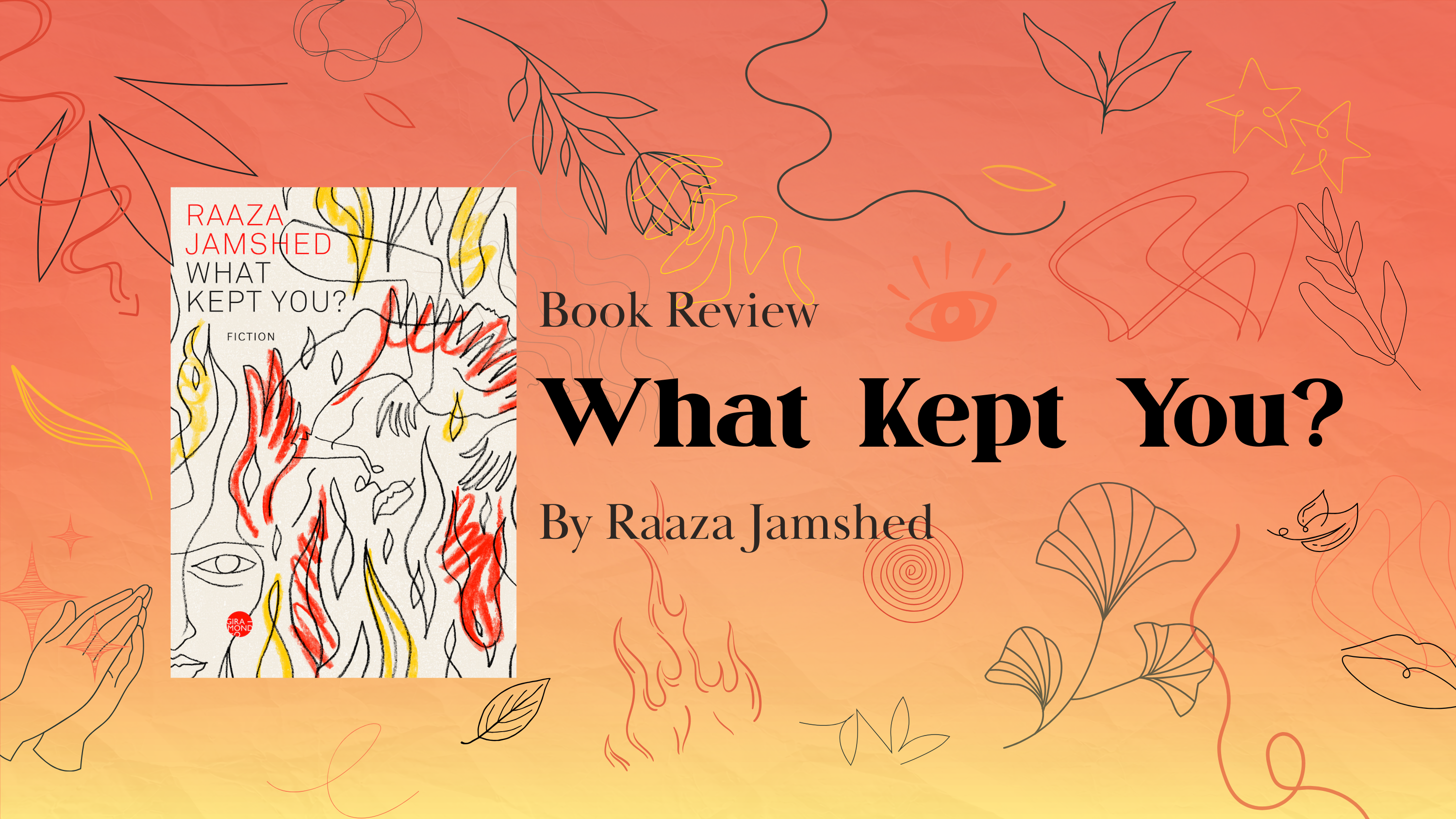
Review by Jeffrey-Michael Kane
Raaza Jamshed’s debut novel arrives from Giramondo with endorsements comparing her to Omar Sakr and Yumna Kassab, but these comparisons, while earned, risk domesticating a book that operates on wilder terms. Jamshed holds a doctorate in Creative Arts from Western Sydney University and edits Interviews and Global Spotlights at Guernica. Her short fiction has appeared in Meanjin, the Sydney Review of Books and Australian Book Review, and her story ‘Miracle Windows’ won the 2019 ABR Elizabeth Jolley Short Story Prize. What Kept You? is a feminist anti-tale that refuses the safety of linear narrative the way its protagonist refuses the safety of walls.
Jahan grows up in Lahore under the watchful eye of her grandmother. She is raised on cautionary stories about demons and disappeared girls—folk tales braided with the collective memory of partition’s violence and forced displacement. As she grows older, Jahan rebels against the constraints prescribed by her matriarchs. She migrates to Australia and settles on a rural property on Sydney’s western outskirts with her husband Ali, whose family is Arabic. The narrative’s central crises are loaded into the final third: a miscarriage that forces Jahan to confront the unruliness of her own body and bushfires that threaten her home. The result is a devastating accumulation—the domestic and ecological converging in a single sustained cry of grief and regeneration.
Jamshed employs a quasi-epistolary structure and shifts between second-person retrospection and first-person dramatic action, braiding Urdu, Arabic and English into a prose that moves between registers with poetic economy. The title’s question—what kept you?—ripples outward: what keeps us from returning, from arriving, from becoming the self we were meant to inhabit?
The novel’s most striking achievement is structural. Jamshed uses Jahan’s childhood home in Lahore—a house surrounded by walls, sitting in the shadow of the city’s fortifications—as a sustained metaphor for the false security offered by borders. What keeps a nation secure is not what keeps its people safe; what keeps a family intact is not what keeps its women whole. The walls that promise protection produce suffocation. Jahan frequently describes feeling stifled, claustrophobic, choking on rancid air. Her departure from Lahore is not flight but a knowing act of feminist self-authorship: she occupies the role of the journeying hero, a structural position typically reserved for men in the stories her grandmother told.
This is not a plot-driven novel. Its propulsion comes from its feminist sensibility, which inflects every thematic, structural and stylistic choice. The alternating chapters between past and present create a kind of double exposure—the young Jahan superimposed on the adult, each illuminating what the other cannot see. The second-person passages are particularly effective, allowing the narrator to observe her former self with clinical tenderness, the way one might examine an old wound that has healed into unfamiliar scar tissue. Jamshed’s prose operates at its best when it achieves what she describes as a ‘concinnity’: an elegant assembly of disparate fragments, each fracture carrying the shape of the whole.
Where the novel occasionally falters is in its middle sections, where Jahan’s recollections of her relationships with Aisha and Choti carry significant emotional weight but can feel untethered from the novel’s larger architecture. The multilingual texture—one of the book’s great pleasures—sometimes works against accessibility without sufficiently rewarding the disorientation. But these are the risks of genuine ambition, and Jamshed earns her difficulties.
What makes this debut remarkable is Jamshed’s refusal to resolve the tension between the inherited stories that shaped Jahan and the new story she is trying to write with her life. The novel does not choose between grief and hope; it imagines a space where they coexist. In a literary landscape crowded with migrant autofiction, Jamshed’s voice is mature, unfettered by formal constraint and genuinely dangerous in the best sense—a writer willing to let language remake the world rather than merely describe it.
J.M.C. Kane is an autistic writer from England, though now claimed by New Orleans, who has spent most of his adult life trying to fit long stories into short boxes. He has worked as a paperboy, a contracting executive, and an amateur cataloguer of human regret—none of which he was formally trained for. His fiction has appeared in almost three-dozen journals that appreciate compression—and his willingness to obey word counts. Kane was Shortlisted for the 2025 Letter Review Prize for Short-Fiction, Shortlisted for 32nd Annual Robert J. DeMott Short Prose Contest (2025), Shortlisted for the 2025 Welkin Award for Fiction, Longlisted for the L’Esprit Leopold Bloom Prize for Innovative Narration, and has recently been nominated for a Pushcart Prize.
What Kept You? was published by Giramondo in July 2025 and has a RRP of $32.99
Leave a Reply