
By Rosie Graham
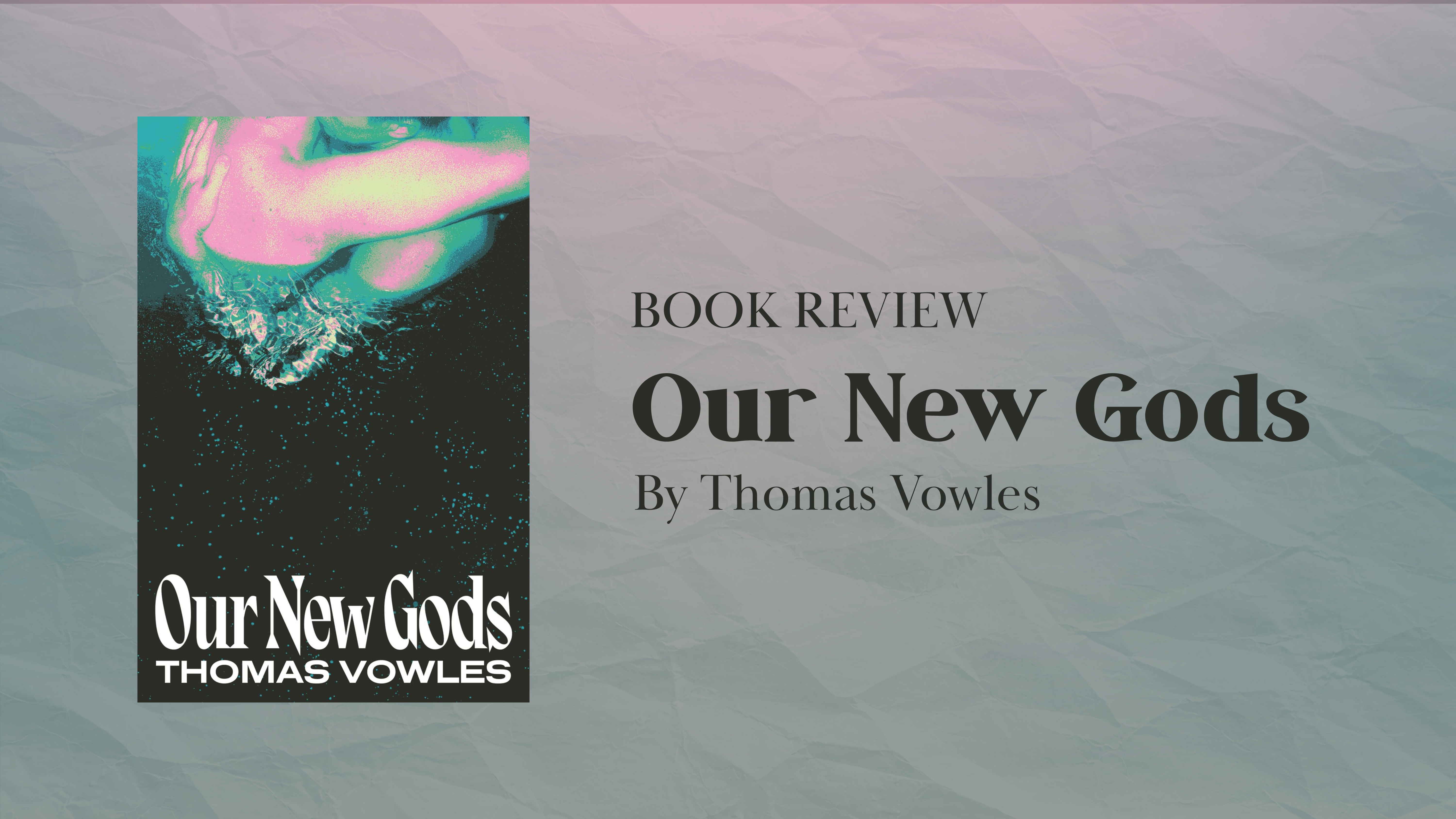
Thomas Vowles’s debut Our New Gods emerges as a daring entry into contemporary Australian literature. With the tonal tension of psychological thriller conventions and the experiential concerns of coming-of-age fiction, the novel takes readers on a gradually unsettling journey to a space where selfhood, perception and desire destabilise the boundaries between what is felt, what is imagined and what can be trusted.
Vowles’s protagonist is Ash, a twenty-something anxious young man from rural Western Australia, experiencing the charged intimacy of Melbourne’s queer scene. When Ash meets the magnetic James, first a Grindr hookup and now a friend, he seeks to escape from his complicated relationship with his late father and a chance to reinvent himself through James’s image and lifestyle. But this attraction mutates into obsession when Ash witnesses a violent outburst from James’s brooding boyfriend, Raf. Whether the event happened exactly as Ash remembers remains deliberately ambiguous. Our New Gods shifts desire away from being a liberating escape, and transforms it into something with the power to erode the boundaries of the self. In doing so, Vowles questions how longing can fracture one’s own identity, and how urban queer spaces amplify both desire and vulnerability.
Although Madeleine Gray calls it a “gay Bildungsroman”, protagonist Ash does not experience linear growth promised by the classic bildungsroman structure. Instead, he oscillates between moments of clarity and uncertainty particularly in how he interprets his relationships and the events around him. His perspective becomes harder to trust as his emotional investment and fixation on James begins to shape how he sees and understands these experiences. While this approach is consistent with the themes explored in the narrative, it demands patience from readers that may find the intensity of internalised obsession overwhelming. It is precisely this discomfort that gives the novel its edge. Vowles is less concerned with resolution than with the representation of affect, perception and vulnerability. In Ash, Vowles creates a psychologically complex and believable protagonist whose anxieties and inane need for connection render him relatable to those who have experienced these grievances. This, coupled with his fixation on the men around him, make his interpretation of events feel increasingly unstable and tense to the reader.
Critics have praised Vowles’s “strong sense of place” and “impressively authentic dialogue” that root the thriller in specific, urban environments. From visits to the Fitzroy pool on a sweltering day and encounters with Brunswick nightlife to a bush doof, each locale is used intentionally to intensify the psychological landscape of the novel. These spaces are sites of miscommunication and erotic power dynamics. Ash’s identity and sense of place is both found and dissolved in Melbourne.
Vowles’s tight prose avoids exposition-heavy descriptions. His background in screenwriting is evident in his precise scene construction and acute attention to sensory detail. At first, Ash is unaccustomed to a world of intimacy, freedom and possibility, but then is subtly written to become both an actor and victim as this world gets darker and more seductive. A visceral scene set in a sauna uses space to explore this transition: Ash experiences intrusive visions of his father in the lustful setting, a toxic overlap of trauma and eroticism. Another scene flashes back to Ash’s childhood home where the floor has a plate-sized hole in it. He imagines its “black throat and its yawning wretchedness” swallowing him whole:
“[…] the next time I saw my father sweeping I thought of the remnants of our bodies collecting in the black under the house. I began to imagine our dead shavings slowly re-forming into empty sacks of skin, […] they were as light as air and almost as translucent, with gaping mouths and awful cavities where their eyes should be.”
Queerness in Our New Gods sits firmly in Melbourne’s inner-north queer scene where connection is often immediate, but shaped just as much by reading and misreading as by anything clearly defined. Vowles writes these spaces for those who have lived them; attraction is built through recognition, proximity and the ways people interpret one another in the moment. What feels intense or meaningful at the time doesn’t always settle into certainty afterwards, as desire and projection shift how events are understood through Ash’s perspective. That emphasis on perception rather than clarity feels central to Vowles’ approach. In an interview with Kill Your Darlings, Vowles attributes his stylistic choices to his desire to make Our New Gods ‘a place to be naughty and subversive’ and ‘to explore the parts of ourselves that we would maybe prefer to hide from’.
Our New Gods is as much a study of perception and unreliability as it is a story of human relationships. Thomas Vowles shapes a story through which identity splinters and urban belonging proves fragile, and the reader is left to navigate how much of Ash’s perspective is shaped by jealousy or projection, or if his interpretation can even be trusted. Whilst the narrative doesn’t resolve itself by its end, it lingers in spaces between obsession and recognition, clarity and self-destruction. Readers will turn the last page of Vowles’s debut not with answers but questions: what remains of the self when desire corrodes perception?
Rosie Graham is currently undertaking her Masters in Creative Writing, Publishing and Editing at The University of Melbourne.
Our New Gods was first published by UQP in 2025 and has an RRP of $34.99.
Leave a Reply