
By Chayin Tengkanokkul
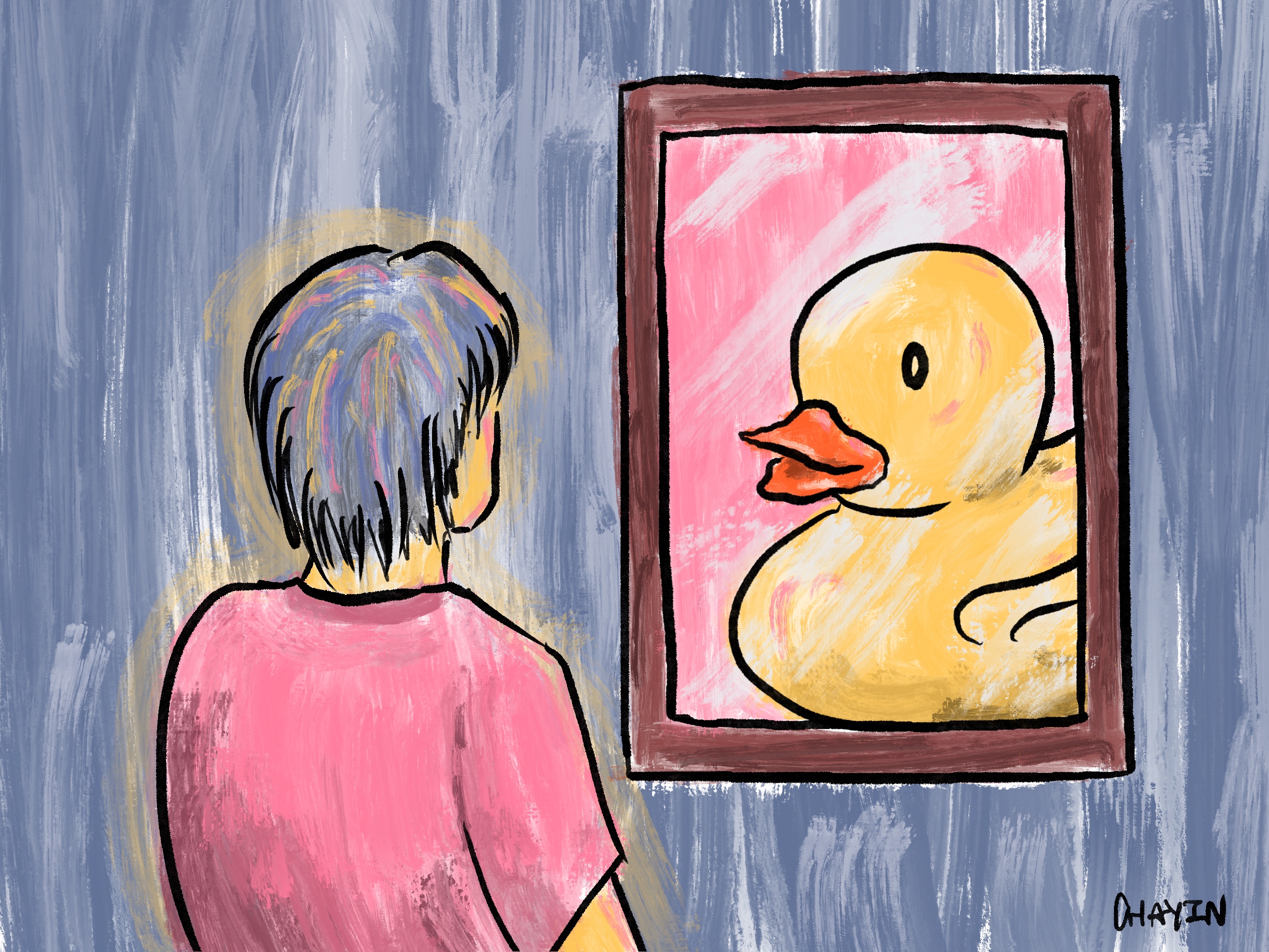
The humble duck can swim and fly but is good at neither.
– Thai zillennial proverb
When I found out I was the designated designer of this semester’s Grattan Street Press class, I got full body chills.
On one hand, I was excited to work with talented authors and showcase my art to a bigger audience. On the other, more menacing hand, I was terrified of taking on the very role I had asked for. My self-doubt kicked in. I looked around the classroom and saw faces of those who have real-life accomplishments and years of experience. I started to doubt myself. Who was I to take on this role when there were more deserving people?
If you relate to this, firstly, I’m sorry. Secondly, and let me hold your hand when I say this—that might be imposter syndrome.
What is imposter syndrome anyway?
When you’ve accomplished something great, yet you still feel like you’re not good enough—that’s imposter syndrome. You might downplay your successes as flukes or feel like a fraud soon to be exposed. You might not even allow yourself to enjoy the fruits of your labour because you feel ‘unworthy’.
There are many types of imposter syndrome out there. Maybe you’re a perfectionist who views your less-than work as failures. Maybe you see asking for help as a sign of weakness. Or maybe you’re like me—a duck.
Duck tales, boohoo!
In Thai millennial-gen-z discourse, the duck is our version of a ‘jack-of-all-trades’. The humble duck can swim and fly but is good at neither.
My duck tale? I’m positively delusional that I am, at best, decent at many things in life. I’m a just above-OK writer and editor, and an artist (cringe) who’d miss out on the community gallery by a fingernail. Everything I know about art and design took years of self-teaching. Cut to the GSP classroom, I felt myself animorphing into that damn bird again.
Make friends with the duck, make peace with the imposter
I went home that day and realised, upon some self-reflection, that maybe being a duck ain’t all bad. I found myself retrospectively proud of my past work, and I’ve yet to be called a phony. I must be doing something right, right?
So, although I’m not a registered therapist, I figured I’d share some takeaways from my experience coping with imposter syndrome.
Start by unpacking why
Inventor Charles F. Kettering once said ‘a problem well-stated is a problem half-solved’. Kettering’s problems were practical, but I find his wisdom applicable to the task of self-realisation too.
In my case, the supposed deficiency of my creative skills stemmed from my upbringing in the Thai education system, where art classes were designed to frighten us. We weren’t taught how to properly hold a paintbrush, yet we were expected to turn in the Sistine Chapel for assignments. Creative writing subjects weren’t even available in my curriculum. When I discovered my love for letters and lines (much later in life), I simultaneously found myself lacking in those areas. I felt like it was too late to do anything about it. My decision to move to Melbourne for postgraduate study and the loneliness I experienced upon seeing no Thai representation in my program only rubbed salt in the wound.
Using this as a jumping off point, I reminded myself that it’s never too late to learn, and classes like Grattan Street Press are there to fill in the gaps. This allowed me to be kinder to myself, and instead focus on the opportunities to come.
Knowing where our problems come from is eye-opening. Your imposter syndrome might come from a benevolent place—wanting to do better or to share your space with others. Take some time to understand the duck you are.
Take advantage of your duck-hood
Alongside the ducks exist the mythical unicorns: individuals who excel in one particular skill. They are the masters of one to the jacks of all.
Both species have their pros and cons, and are equally crucial in real life. Unicorns jump start a project with their mastery while ducks fill in the unicorns’ gaps and provide support. It is this collaboration and synergy that drives our society forward (I learnt this from a Ted Talk years ago and it blew my mind).
Where ducks lack singular expertise, we make up for it with versatility. In a fast-paced world, being adaptable is advantageous. Studies and industry experts have revealed that being a bit good at everything means we’re better at problem-solving. Moreover, as ducks, we’ve dabbled in everything, meaning that we’ve had the mileage to discover which skills we want to improve upon and then push ourselves towards that improvement.
Ducks don’t have to master everything—not even one thing. That’s the unicorns’ job, so chill out.
Know you’re not alone
Lastly, and I found this out only after—of course—talking to multiple people, we’re not alone. There’s an imposter syndrome subreddit with twelve thousand members sharing their stories hourly. You might even have something in common with your favourite celebrity.
Reaching out is a step towards resolution. You’ll be surprised to know that you’ve been surrounded by ducks and imposters this whole time. You might even discover, after all, that you’re not so different from those you think are better than you. Being more open about it also gives you a chance to vent and get rid of those irrational thoughts that fuel your imposter syndrome.
Imposter syndrome: living with it
Having said all that, I’m still reckoning with my imposter syndrome, and I know that it’s not going away any time soon. While I’m not fully recovered, I’m comforted to find this anxiety is shared. Knowing that I’m not the only one struggling has helped me to feel less lonely in my journey. To me, this blog post is as much a PSA as it is a step towards coexisting with (or even being free from) imposter syndrome.
I’m super grateful to be surrounded by such lovely and supporting GSP peers, and I’ve been going to subsequent classes with much more confidence.
So if you’re a duck with imposter syndrome like me, just talk about it. Write. Make art. I know at least for me that I’m already feeling better the closer I get to finishing this blog.
Now watch this duck become stronger!
Dealing with imposter syndrome is a work in progress, not a race to the finish line. The same goes with creating art. So, if you have a manuscript you’re working on and seeking feedback about from the public, why don’t you submit it via our Work in Progress feature?
If you’re struggling with mental health issues, please consult your general practitioner. University of Melbourne students can contact CAPS for free counselling sessions. You may also reach out to Beyond Blue and health direct for additional resources. You’re not alone.
Chayin Tengkanokkul is a writer, illustrator and self proclaimed procrastinator. He loves ‘looking for inspiration’ in record stores and book shops of the Melburnian inner north.
Feature illustration by Chayin Tengkanokkul.
Leave a Reply