
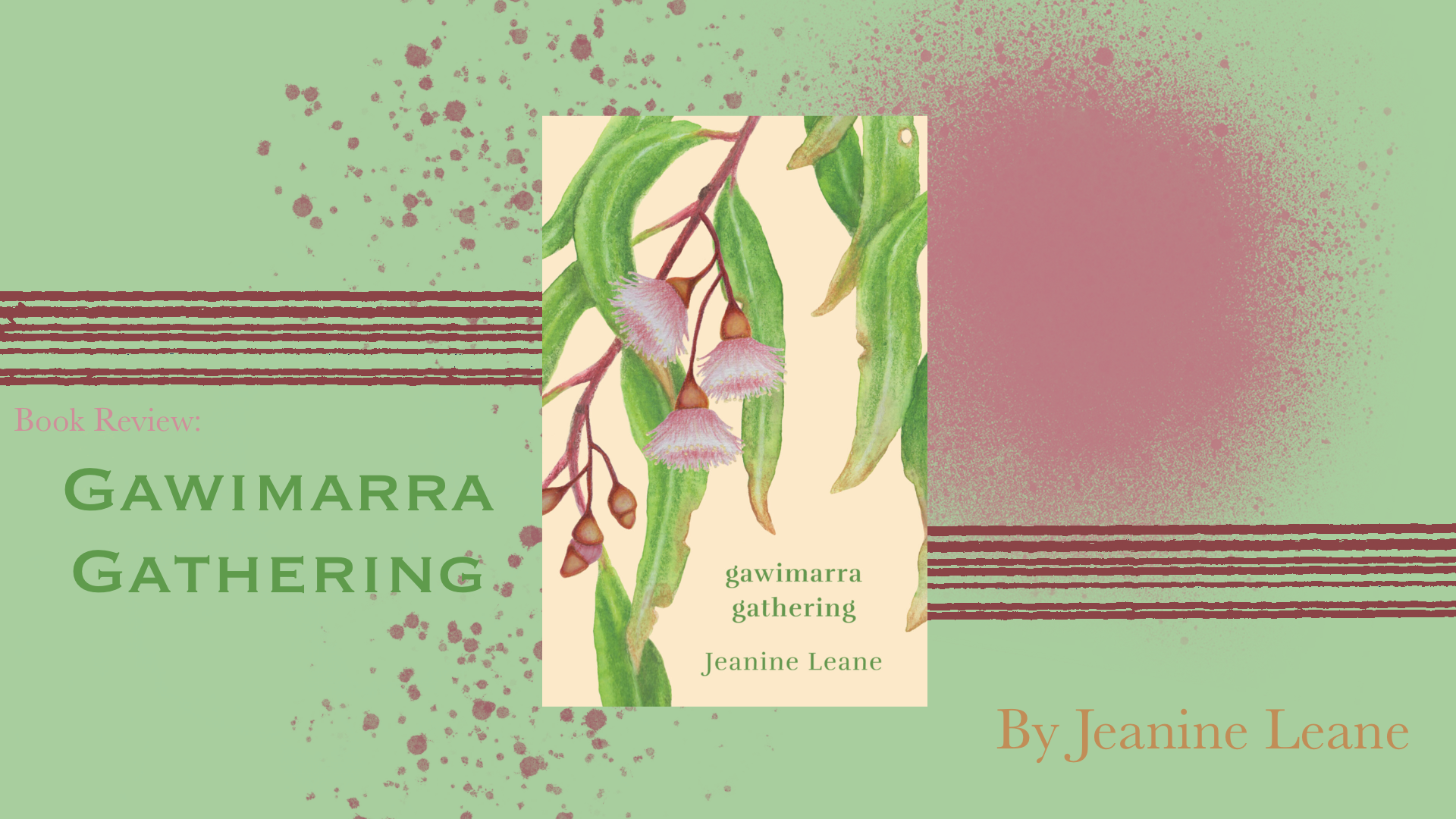
By Thriveni C Mysore
Gawimarra declares that its writer, Jeanine Leane, is a poet. She is a proud Wiradjuri writer who is proud to be Wiradjuri. Proud to be on Wiradjuri land. Proud of her culture, language, people and ancestors. And she is proud to be on this side of the feminist barbed-wire fence. Sharing her thoughts about standing for First Nations Australians she says:
First peoples learnt to know Country from the ground with our feet – we learnt to know it, to hear it, to feel it, to care for it, to love it from our grandmother’s feet on the ground, through our mother’s feet on the ground our ancestor’s feet on the ground, our feet on the ground. We learn Country from sole to soul. Country remembers all who have walked it, long after our footprints are gone. Long after they have been erased by time. Long after the lands that hold them have been invaded, stolen, built on. Country remembers each imprint – its shape, its tread, its feel, its walk.
This passionate tone resonates in her writing. In her article published in Overland, ‘Other peoples’ stories,’ she says:
… why do you want to speak about Aboriginal people when you can never speak for Aboriginal people or be an Aboriginal voice, just like I can’t be a white one, even though, like a lot of Aboriginal people today, I am immersed in settler culture on a daily basis?
I know now that my aunt was correct. Without knowing us, our histories, our stories, it is impossible to ‘write’ an Aboriginal story – any attempt at representation would be merely self-serving cultural appropriation.
Cultural appropriation is not empathy. It is stealing someone else’s story, someone else’s voice.
The poet celebrates the cultures of her land in her delicate words. The poetry melts into us beautifully and stays, as in the poem Weaving Glass:
Like Aunty Jenni Kemarre Martiniello,
Who takes sand from the desert melted into liquid to form
solid-brittle glass
bends it like reeds through her fingers
… blends old ways with new mediums to say: We Are Still Here p. 12
Gawimarra Gathering— a collection of 54 poems — is not a one-time read. It is basically a systematic pattern of true emotions, distributed in lines. Even if a reader does not belong to the said Country, the reader feels so drawn to the culture and magnetic language, that a sense of being among the people of the poet’s Country dawns unawares. A keen sense of interest in the language develops and leads the reader to know more about it. This feeling of wanting more marks the success of any literature and Gawimarra surpasses in bringing that buoyancy.
Answering a question, for Missing Perspectives, about whether poetry was her natural choice for the form in which these stories would exist and be passed around, Leane says:
I do write a lot of poetry, but I toyed with a lot of ideas about how to put all of this together because I do write a lot of other things, essays and prose. But ultimately, I decided on poetry because you know, the kind of poetry we’re all used to being exposed to was pretty toxic, really, and I wanted to flip that on its head,” she says. “I wanted to write about these intergenerational micro histories, because I think a lot of people maybe do understand colonialism on a big scale, a big picture. But I think that idea of micro-colonialism and what we survived and what we have achieved as First Nations peoples, particularly women, I think it’s still largely underrated in this nation.
In Wiradjuri language, Gawimarra means gathering. The poet wants to‘…gather words / upon pages / untangle thoughts / make them speak…’ and says that Blak poetry is like the maliyan (eagle):‘unbounded by fences bodies of water / or concrete buildings –it soars.’
The exchange of gifts between Mother Nature and human beings must be gentle. The difference between those gentle with nature and those who plunder nature is well put in the opening poem, The Gatherers. The poet writes:
– gather only what is needed –
gather to return – return to gather
…
to gather is to release
…
Colonial collectors come steal and kill
Gatherers are dispersed hunted herded – collected
as artefacts – recorded as anthropology – listed
in catalogues… p. 4 – 5
The poet explains that ‘collectors do not give back what they take.’ Unable to come to terms with the way historians handle the facts of intricate culture, Leane says:
…history is not the past…
…history isn’t even what happens…
…history is just one story labelled as truth… p. 36
Addressing the burning issue of colour, the poet lays bare the facts delicately on the table and leaves it to the discretion of the readers to experience the pain and agony that comes with it. In her poem, Black Child, the poet says:
My life not yet lived, but my existence already
Theorised by my Black skin. p.7
Another poem, On International Women’s Day, reads:
Between my skin and my womanhood
and my womanhood and my skin are blood and bone.
My skin is Blak. Inside is my womanhood.
Do I peel my skin from my body
or wrench my body from the skin? p. 43
They Said I Could Be a Feminist, speaks of being in the wrong skin, wrong sex, wrong age, wrong nose, wrong hair and crashes down: ‘I am the problem everyone seeks to solve.’ Leane continues: ‘Do I bleed the woman from my Blackness?/ Or drain the Blackness from my womanliness?’
About climate change, the poet says there is no word in her language for environment, or climate. She explains: ‘The world will die by denial …/ while we’re waiting to see it on the news the next day.’
Leane raises her impactful voice — be it on climate change, feminism, or the deforming of living cultures in the name of progression — and reverberates it through the whole cosmos. Through this powerful assonance, the poet wants to reclaim her culture, her language, her territory, her roots, her living river, her dreams of ancestors’ knowledge, her country, her kinship. The poet of Gawimarra rubbishes the insecurities of human nature and wants to reclaim, rewrite and chronicle the genesis of culture-rich Wiradjuri Peoples.
‘Man’s goodness is a flame that can be hidden but never extinguished.’ These words were written by Nelson Mandela in his book, The Long Walk to Freedom. Jeanine Leane’s Gawimarra Gatheringis one such flame in First Nations literature that can never be extinguished.
Gawimarra Gathering was first published by The University of Queensland Press in 2024 and has an RRP of $24.99. It is available from most online and local retailers.
Thriveni C Mysore is a science teacher from Karnataka, India. She loves Nature poetry. Her reviews have been published in Plumwood Mountain Journal – An Australian Journal of Ecopoetics and Compulsive Reader. She finds solace in writing her own poetry and essays on Philosophy.
Cover image by GSP editor Finn Zucchi, used with permission.
Leave a Reply