In this second extract from Najis: A Memoir, Sydney-based writer Robert Douman recounts his family’s life in Tehran and his mother’s decision to move to Australia to provide a better future for her children. Now that they are in Melbourne, however, the family begins to question whether that decision was right.
Terrace
Blandina, Tehran, 1967
Blandina and her family live in her parents’ house, a run-down three-storey adobe terrace. Her father, Hartoon, lives in the basement. Her mother, Esther, shares the first floor with her brother, Sarkiss, and sister, Kristina. Her husband, Daryavoush, is driving his truck somewhere far away, so it is only Blandina and her children on the top floor, the hottest part of the house.
Joquelin tosses and turns, unable to sleep in the heat of the night.
‘Can we go up to the roof?’ pleads Rohbert.
From their room, a short rickety ladder leads to a hatch, through which they can crawl outside. All the terraces have flat roofs and are connected to each other, and on a night like this, everyone climbs up for a welcome relief.
‘Esther, can you sleep?’ Blandina yells downstairs.
‘I’m floating in my sweat,’ Esther replies.
There are carpets already laid out on the roof, so they collect their bedding and go up.
From the roof, trucks can be heard whistling down in gears as they approach the nearby roundabout. There are ventilation pipes jutting out from houses; rusting satellite dishes stare with their anonymous faces towards the sky and the blue moon hanging there.
Neighbours, right down to the end of the street, are already outside. Everyone waves and greets each other. Three houses down is their neighbour, Jebbah. When he sees Blandina, he grabs a bottle of the homemade khomroh, wine, he takes great pride in making and steps over the parapets towards her.
Blandina takes down Esther’s washing lines and packs away Sarkiss’s backgammon set just as Jebbah arrives.
By the time Blandina finishes setting out the bedding, Jebbah’s wife and children appear with their samovar and glass cups for tea.
Esther brings up chada and nazukeh—sweet, crumbly cakes with a moist, ground nut centre. Jebbah greets her, saying, ‘Khaltee Esther,’ Aunty Esther, ‘please taste my khomroh.’
Another family step over with a pot of spiced tas-kabob stew, flatbread and plates.
Soon, they are just three families sitting together talking, laughing and eating in the gentle breeze of the night. The children get their second wind and start playing together.
When the neighbours leave, Blandina drags the bedding to the middle of the roof, and they all settle down to sleep in a big huddle. Later in the night, Esther gives her a gentle shake.
‘Blandina, Blandina, wake up. Did you hear about the child that fell off the roof today? God forbid if…’
The thought sends a shiver down Blandina’s spine.
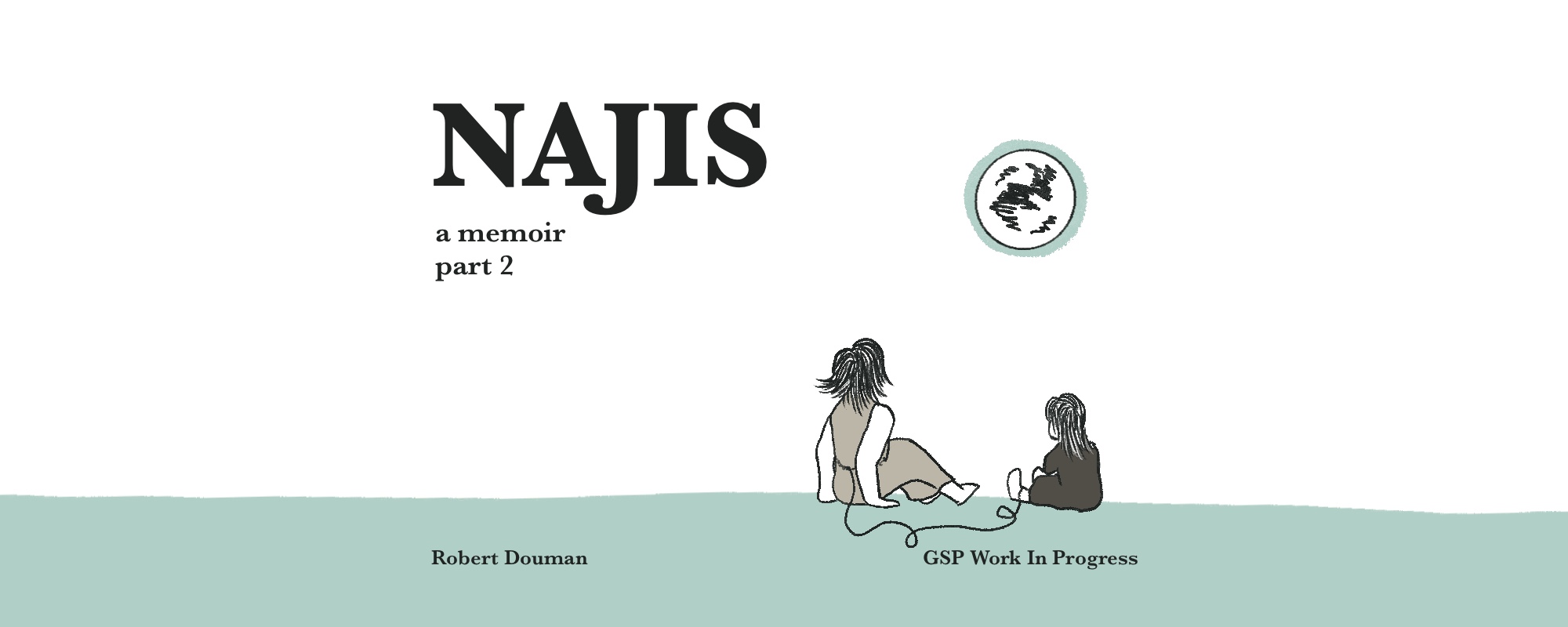
In the village, people bind their daughters’ legs together to make them grow nice and straight instead of bowing. This gives Blandina an idea. She brings up some rope, ties one end to Rohbert and Joquelin’s feet, and the other to her waist. Esther nods in approval.
Blandina lies back and stares at the moon. She remembers back to when she was a child in her village, Ardishai, looking up at the moon and asking Esther, ‘What’s that eye in the sky?’
‘That is God,’ her mother replied.
‘Why does he stare at me every night?’
‘To make sure you are being a good girl.’
From that moment, every night, Blandina looked up at God. She noticed that He was always angry when she had done something bad and happy when she had helped her mother and father—when she had been good. On the angry nights, she crossed herself and prayed to Him, promising not to be naughty again.
That memory brings a happy tear to her eye, and suddenly, she desperately wants to hug Esther. But Esther wouldn’t like that—Hartoon always refers to her as prezlah, iron beam. Instead, Blandina rests her hand gently on the loose hem of her mother’s nightgown.
The cool breeze weaves between their limp, drowsy bodies, gently caressing Blandina into a deep sleep.
At dawn, the children wake up, confused to discover they are tied together.
Joquelin, who is only four, flutters her long, curved eyelashes.
‘What’s this?’ she asks. They laugh at Blandina when she explains.
‘But I need to pee!’ says Rohbert.
Blandina brings a finger to her lips, shushing both children. ‘Your nunu is still asleep. I’ll give you enough slack to get you to the edge of the roof.’
They all continue to lie there lazily for a little longer, but Blandina has not forgotten that she has made arrangements to visit her first cousin, Joo-an, whom she grew up with in Ardishai.
Without waking Esther, Blandina takes the children downstairs to dress them and then slips out the front door.
Along with her four daughters and son, Joo-an occupies the first floor of a large tenement. Her husband, Yokhanna, is away, and has been for many months, but where and why remains a mystery. He is well educated and capable of doing many different jobs. People say that because he is so intelligent, he cannot settle on one career. He had a stint in Kuwait as an accountant, taught French at a high school, and even operated a dental clinic for eight years in Miandoab—learning dentistry from Odisho, Joo-an’s younger brother. When Joo-an and Yokhanna were first married, Yokhanna would be away somewhere for work almost all the time.
However, for the last few years, he has been working as an accountant at a large firm in Tehran. He told Blandina he was happy to stay with the company and to be close to his family. It seems strange that he has gone again, and because Joo-an has not mentioned him, Blandina is suspicious. She is not going to pry though; it would be disrespectful, despite being family.
Blandina visits Joo-an almost every day and every time, Joo-an insists, almost begs, her cousin to read her fortune from her coffee—an old tradition passed down from Blandina’s grandmother.
She can sense that whatever it is that Joo-an is trying to learn from these readings, it is connected to her cousin’s big secret.
In the dining room, the children play with their dominoes on the cool tiles beside Blandina’s feet while she waits at the table. She can see Joo-an in the kitchen pouring the coffees, always thick, black and sweet.
A cool breeze blows the curtains open, almost knocking over the delicate ornaments sitting on her telephone table. Beside the telephone is an elaborate ivory frame housing a picture of Yokhanna. It is surrounded by tear-sodden balls of tissues.
When Joo-an is seated, Blandina tells her that on this warm day it is good to be indoors, drinking coffee with a favoured relative. Joo-an smiles, but Blandina can see that this small talk is irritating her; she keeps apologising for not listening, asking Blandina to repeat things and then not listening again.
Finally, they drain their cups and turn them over in the saucer, allowing the remaining coffee grounds to run down the sides of the cup. After a minute, the stains are set—the fortune-telling can begin.
‘I can see there is something on your mind. It is something of great importance,’ Blandina says. A coy smile stretches across Joo-an’s face. ‘A great journey awaits you.’
Joo-an looks like she has stopped breathing, making it clear to Blandina that she is on the right track.
‘But first, you are waiting on a word. Don’t worry, those words are approaching—look, the words are sitting on the wings of a bird, flying this way.’
She asks Joo-an to open her heart by pressing her thumb hard into the bottom of the cup, clearing it of coffee grounds. The heart is where the deepest thoughts and desires are locked up—this influences their future.
‘This person wants you to know that he is thinking of you and that very soon you will be together.’ Blandina stops and puts the cup down, waiting for a response.
Joo-an takes a long time to compose herself.
‘We’re waiting for word from Yokhanna,’ Joo-an whispers.
‘Where is he?’
‘Australia.’ She is excited.
Blandina is stunned, though perhaps as a fortune teller, she should not be.
‘What’s he doing there?’
Joo-an says that Yokhanna went to Sydney because the Australian Government was paying for immigrants’ airfares in order to populate the country with more workers. They are planning to emigrate as soon as Yokhanna arranges accommodation and is fully employed.
‘I’m shocked, Joo-an. I don’t know what to say…Why are you leaving?’
Even though she asks the question, Blandina knows why. It is the same reason everyone leaves. But her defiant side rises.
‘Khatee,’ sister, ‘running away can’t be the solution. Yokhanna himself always says “We will build more churches, more schools, write more books, form political parties”…’
‘Meshykha notereh,’ Joo-an laughs. Jesus bless him. ‘We’re worried about our daughters. Medi, Yokhanna’s Muslim friend from work, a man he has known for decades, told him that Christian women are shameless harlots because they don’t wear a headscarf. He said, “Head hair or pubic hair, what is the difference?” I become furious when I think how many times we invited that man into our home, sitting around this table dining together like family! That’s the thinking here, Aziztee,’ my dear, ‘to keep our daughters safe!’
Blandina looks at her children playing, knowing that Joo-an is right. Even yesterday, Rohbert came home complaining that his best friend, Moshin, called him a ‘dirty Christian.’ They will never be given the opportunity for a good education, a good job, or a voice to speak their mind and express their faith.
She dreams, even if for a short moment: Rohbert could follow in the footsteps of her cousin, Eden Pireh, who became a respected professor in Australia after his father sent him to university in the West. Blandina knows that she could never afford university for Rohbert in Tehran; the Persians would never allow an Assyrian to reach such heights over one of their own. Maybe he has a chance in Australia.
Blandina is still apprehensive though, recalling that people who had come back from abroad would often say how things are just as difficult there, if not worse. No-one believed them. The villagers asked why, if the West was so bad, were there people living in great big mansions, driving Mercedes-Benzes, and dressing like movie stars? But Blandina’s father, Hartoon, who had once worked in Kuwait, would still say, ‘Paradise is right here my girl, in Ardishai, in this village, on our farm.’
***
Over the months that follow, Joo-an and Blandina continue to meet, gradually referring to Australia as perdesa, paradise. Of course, all of these meetings are kept private because, by now, Blandina is thinking about following her to perdesa. If Esther finds out, she will forbid her from visiting Joo-an altogether.
Blandina learns that Yokhanna is sponsoring Joo-an to emigrate, and that someone else from Ardishai, now living in Melbourne, could sponsor Blandina’s family.
Blandina begins to correspond with Esokh, and as she cannot read or write, Rohbert writes on her behalf. This is risky, as her son is very close to his grandmother, so she warns him, ‘You’re not allowed to tell anyone about these letters, do you understand? Not even Nunu.’
However, Esokh writes back with the message, ‘DON’T COME!’ Blandina is disappointed, until she finds out that he says the same thing to everyone, including Joo-an.
Blandina responds, ‘Yokhanna is saying different things. He’s saying the Australian Government looks after you in every way, especially when you’re old.’
‘There is an old English saying, Khatee,’ sister, ‘they will “get their pound of flesh”,’ writes Esokh. ‘That means that you and your husband will have to work in their factories. People have lost their arms and legs using their machines! And if you don’t work, what are you going to do all day when he’s at work? You’re too young to sit between four walls, all day, every day. How will you manage?’
Esokh tells Blandina that although he is a qualified accountant in Iran, in Australia he works as a floor cleaner. This news comes as quite a shock to her. When Esokh was a young man in Ardishai, people would refer to him as ‘Ovoh ahrteetoo ghourtela,’ he whose fart is big—who thinks they’re better than everyone else.
When Blandina goes to see Joo-an, she tells her what she has learned from Esokh’s letters.
Joo-an laughs. ‘Don’t worry too much about what Esokh says. He’s young and emotional. Maybe a pretty girl has just broken his heart. Tomorrow he’ll meet another one and suddenly Australia will be paradise again. Listen to Yokhanna, he’s older and wiser. He knows the way people of our generation think and what’s important to us.’
Nine months after the first fortune reading in her apartment, Blandina and Joo-an are together at the airport in Tehran. Just before Joo-an is about to board her plane for Sydney, she whispers in Blandina’s ear, ‘Keep going to the immigration office and follow up on your paperwork. Stay on their backs and we’ll see each other in perdesa.’
Factory
Blandina, Melbourne, 1969
The family are in the kitchen in perdesa. Instead of heavenly clouds, black spores seem to be hovering above their heads, and instead of angelic harp music, Esokh is telling Daryavoush to look at things differently in Australia.
‘Babi, you can do it on your own, but to get ahead in this country both you and your wife will have to work.’
Daryavoush scoffs. ‘A woman’s place is in the home. Aha ila shedanooyta,’ this is madness. ‘She has never worked a day in her life. Where is she going to work? What can she do?’
‘Lubah’s husband runs a factory. She’ll find something for Blandina.’
Daryavoush sits upright, outraged. He’s the sole provider, the one who brings home the food and treats we eat; the one who takes our entire family to restaurants and movies. But Esokh doesn’t seem to understand that—maybe he doesn’t care.
Daryavoush stands up and yells, ‘They will stare at her!’
‘She won’t be the only woman there.’
‘I don’t care! They can look at their mothers!’
Blandina’s face turns red and she shakes her head at Rohbert not to listen. Daryavoush retreats back into his seat slowly, continuing to watch Esokh with suspicion.
‘Babi,’ Esokh says, veins bulging in his neck, ‘this is “the enlightened West.” We have to get rid of those antiquated ways. Otherwise why come? It’s not enough to fit in, we have to get ahead!’
For Daryavoush, at forty-three, these new concepts are adding extra weight onto our already wobbly table. His brain is struggling to bear the load, and he stares hard into his tea. ‘Do what you think is right,’ he mutters.
***
Blandina’s first job in Australia is at a pie factory. She does not know what she will be doing, but at least it does not require her to speak English.
The factory is managed by Iraqi Lubah and her Australian husband. Blandina brings Rohbert with her when she meets Lubah to learn more about the job.
As Lubah serves them tea, Blandina gives her a box of chocolates. It is customary to bring a gift when visiting someone in their home for the first time—usually something sugary to wish them a sweet life.
Rohbert pulls on his mother’s arm and points at miniature clay figurines lining the mantel and then at the ornate ceiling rose. Blandina nods, also impressed. ‘Aveh breekhoh, khatee.’ Congratulations, sister.
‘Meshykha tayber gha-deeyokhoonzeh,’ May Jesus take care of you too, Lubah replies. Blandina is surprised that Lubah can say that customary phrase so fluently. When they first met, Lubah spoke mostly in English; it was almost impossible for Blandina to understand what she was saying.
Lubah then describes Blandina’s new job. The factory needs someone to operate a slicing machine; cutting out the core of cauliflowers with a knife and then tossing the remainder into the machine to be chopped down for the pies.
Blandina recalls how, when she was a little girl, the village elders would say that the West uses machines to make all their foods; that is why everything they eat is poisoned and cancer is ravaging their bodies.
‘But don’t worry, khatee, they will show you on the job,’ says Lubah, noticing the anxiety on Blandina’s face.
Despite having nightmares about the machines, Blandina arrives at the factory bright and early the following morning. Lubah’s husband gives her a lot of instructions, none of which she understands. But he makes it perfectly clear that Blandina should not throw the cauliflower core into the slicing machine. He goes so far as imitating the sound of machinery breaking if the core goes into the vat.
Blandina does it exactly the way that they have shown her, at least the first few times. It is very hard, heavy work to cut those enormous heads of cauliflower; a niggling headache from a lack of sleep is not helping either. Meanwhile, the conveyor belt keeps bringing more.
The cauliflowers begin to pile up . Blandina has never seen anything like it—her arms are burning with pain.
Suddenly, she panics and throws the entire cauliflower into the machine.
‘What have I done?’ she whispers, staring into the vat.
For a moment she thinks that she has gotten away with it because it keeps working. But then, it makes a loud roar and stops. A technician comes running.
‘Why has the machine stopped?’ he asks, breathing heavily.
Blandina shrinks when Lubah’s husband arrives and sees the cauliflower jammed between the blades. He calls his wife.
‘Darl’, would ya take a look at this.’
‘Khatee, lah,’ sister, no, Lubah says. Lubah tries her best to explain to Blandina in Assyrian what to do, assuming she did not understand earlier.
While Lubah talks, Blandina has a chance to rest and now feels confident that she can manage. Besides, she does not want to go home defeated—her family needs the money. She apologises and says it will not happen again.
However, after a short while, her arms begin to ache even more than before. Blandina tries to endure the pain, but it is impossible, so she sits on the ground and just lets the cauliflowers pile up beside her. Again, the technician rushes over. Blandina clutches her arm and grimaces at him.
The managers move her to another conveyor belt—this one carrying the finished pies on foil trays. Blandina’s job is to pick up the trays and stack them on shelves in a fridge. However, the conveyor is running so fast that she can’t keep up. Exhausted, she stops working and sits on the floor. The pies keep coming and eventually fall onto the ground beside her, making a terrible mess.
Lubah’s husband shakes his head and says, ‘Mate, I don’t believe it. Is she doing this on purpose?’
‘Khatee lah, not like this,’ Lubah says again in both languages. ‘Work more quickly. Husah-nay shoolah,’ It’s an easy job. ‘You don’t need muscles.’ She points to her arms.
‘Aziztee,’ says Blandina, ‘it might look easy but it’s not. They’re never ending. Why can’t they slow the machines down? Soyseh empeelenah boreh?’ Are horses chasing them?
Lubah shakes her head in disbelief, telling Blandina that her husband thinks she will ‘stuff up’ whatever job he puts her on.
Blandina lowers her head, ashamed for being a burden and for being spoken to in this manner. She decides the honourable thing would be to apologise to Lubah and her husband and leave them in peace.
To Blandina’s surprise, they do not fire her but give her another job peeling onions and putting them into a smaller machine.
‘Ay god!’ she says to Lubah. ‘This is the worst job of them all.’ Blandina’s eyes are stinging and watering so much that she cannot see.
Finally, they move her to a simple job: taking empty foil trays out of a cardboard box and putting them onto a conveyor belt. But she is very slow at this too.
At the end of the day, Lubah tells Blandina that Australia is in desperate need of workers. Lubah points to a big poster on the wall showing men working in different industries like railway and shipping. Blandina hones in on an image of a house on a green patch with fruit trees and distant mountains. It has a caption reading: ‘Land of Tomorrow’. It reminds Blandina of her childhood home.
Lubah explains that the poster is from the ‘Populate or Perish’ campaign—employers are encouraged to train their workers rather than fire them.
But Blandina also knows that Lubah and her husband are kind-hearted people who care about her and her family.
In years to come, Blandina will tell the story of her first day in the pie factory many times. Friends and family who visit will bust their sides laughing at Blandina’s nerve, never seeming to grow tired of it.
For Blandina, the story will be a reminder of what she endured for her family.
Don’t stop now!
Part 3 available next week
Robert Douman is a Sydney based writer of Assyrian heritage. He was a chemical engineer, world traveller, football player and hopefully, one day, will be a full time writer.
All illustrations and images are the copyright of Chayin Tengkanokkul and Grattan Street Press.



Leave a Reply